Membership Community · Platform Consolidation Case Study
Four tools collapsed into one OS.
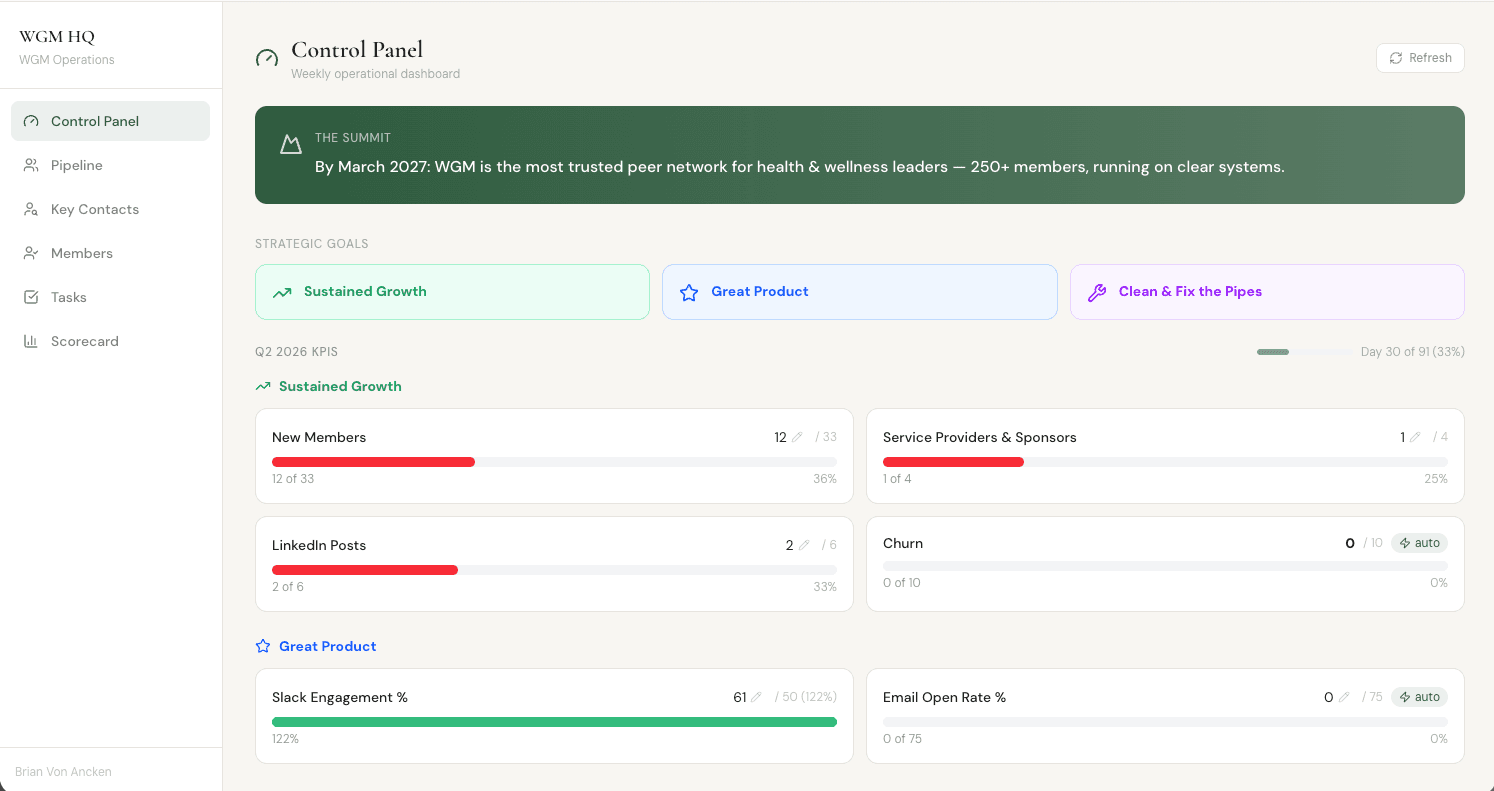
A 350-member community was being managed across Airtable, Notion, Luma, Gmail, and more — scattered, duplicated, and impossible to scale. We built a single unified database that serves as both the member-facing front end and the operational backend for the team running it.
platforms consolidated into one operating system
members managed from a single database
pipeline visibility — leads to conversion to nurture
time spent jumping between disconnected tools
Problem
The operational constraint
The company had a high-value workflow that still depended on manual analysis, scattered systems, and human follow-up. The limiting factor was not demand. It was operational capacity: the business could not scale the workflow without adding more people, more handoffs, and more management overhead.
A 350-member community was being managed across Airtable, Notion, Luma, Gmail, and more — scattered, duplicated, and impossible to scale. We built a single unified database that serves as both the member-facing front end and the operational backend for the team running it.
System Design
The AI agent operating system we deployed
Member-Facing Front End
- →Centralized resource hub — members access everything from one place
- →Event management and registration without jumping to Luma or external tools
- →Community content and updates surfaced automatically, not manually distributed
Team Operations Backend
- →Lead pipeline management — track, score, and convert from one view
- →Member nurture sequences triggered automatically on join
- →Team-wide visibility into every stage of the member lifecycle
Unified Brain
- →One central database replaces Airtable, Notion, Luma, and Gmail
- →Every team member sees the same source of truth — no conflicting spreadsheets
- →Pipeline, content, events, and member data all interconnected
Business Impact
What changed after implementation
- →Eliminates platform-switching overhead — your team operates from one screen, not five tabs
- →A unified brain means every team member has full context without asking or searching
- →Pipeline management and member nurturing live in the same system — nothing falls between the cracks
- →Directly applicable to any organization managing communities, cohorts, or membership programs at scale
Why it ranks
Relevant for companies researching practical AI implementation
This case study is a concrete example of AI moving beyond prompts and tools into owned business infrastructure. The pattern applies to established companies that need AI agents connected to real workflows, clear governance, human review points, and measurable operating leverage.
SterlingAI uses this style of engagement for leadership teams evaluating fractional Chief AI Officer support, AI implementation retainers, workflow automation, and practical AI agent systems.
Next step
Find the first AI employee your company should build.
If your company has similar operating constraints, start by identifying the first role AI should own, the workflow it should improve, and the ROI signal leadership can measure.
Canonical URL: https://sterlingai.dev/case-studies/membership-community-operating-system